Waste Management Under Victoria’s New ResiCode: Why Early Input Matters
- Jul 20
- 2 min read
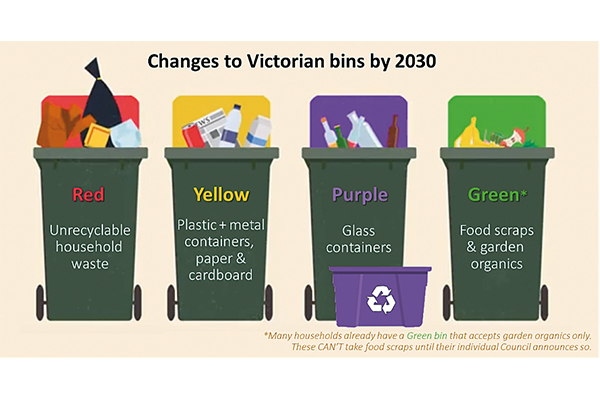
Waste management is becoming a more important design consideration under Victoria’s new residential planning requirements.
For townhouse projects assessed under Clause 55, waste is no longer just a report prepared at the end of the planning package. The waste strategy can affect the site layout, garages, front setbacks, landscaping, access paths, collection points and Council acceptance.
The key question is not only “how many bins are required?”It is also “what waste arrangement will actually work for this site, and what is Council likely to accept?”
Individual bin areas or a common bin area?
For townhouse developments, Clause 55 allows either individual bin storage areas for each dwelling or a shared/common bin storage area. The minimum bin storage requirements are summarised below.
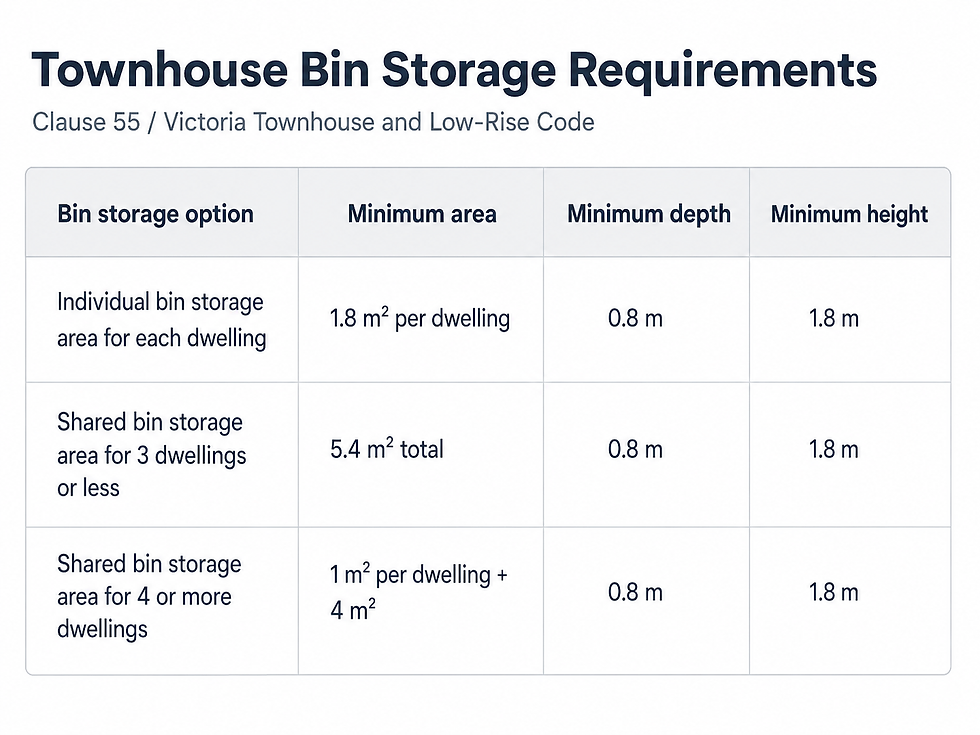
While the table is helpful, meeting the minimum area does not always mean the waste strategy is resolved.
For example, individual bin storage may be suitable where each townhouse has good street access and enough space in the garage, POS. However, it may not work well if bins need to be dragged through narrow paths, across long driveways, or through areas intended for landscaping and canopy planting.
A common bin area may be more efficient for some sites, but it needs to be carefully located and designed. Shared bin areas need to consider access from each dwelling, bin transfer distance, screening, bin washing, odour, presentation space and collection arrangements.
Council collection or private collection?
This is another key issue that should be resolved early.
For some townhouse developments, Council kerbside collection may be appropriate. However, this depends on the number of bins, frontage width, street conditions, collection point location, and whether bins can be presented without obstructing driveways, footpaths, street trees or services.

For more constrained sites, private collection may need to be considered. If private collection occurs on the land, the accessway needs to allow the collection vehicle to enter and exit in a forward direction.
This is why early waste input is valuable. The preferred strategy can influence the layout before the design becomes too fixed.
Small details that are often missed
Clause 55 also requires each dwelling to provide an internal waste and recycling storage space of at least 0.07 m³, with a minimum depth of 250 mm. This is usually addressed within kitchen joinery, a pantry, laundry or utility area.

The takeaway
A Waste Management Plan is most useful when it is prepared early enough to guide the design.
Early engagement can help the project team confirm:
whether individual or common bin storage is more suitable;
whether Council collection is likely to be accepted;
whether private collection is required;
where bins should be stored and presented for collection;
whether swept path advice may be needed; and
what waste-related items should be shown on the architectural drawings.
Leaving waste until the end of the planning process can lead to avoidable RFIs, redesign, or a collection strategy that Council may not support.
For townhouse projects, waste management should be considered as part of the early planning process — not just as a compliance item after the drawings are finished.
Comments